Cicada Ink Studios: The Art of Robin Corbo
Mural Making FAQs
Part of the mission of Cicada Ink Studios is to provide the public with information on how to make their own mural. Below is a list of common things I'm asked regarding the mural painting process. If you have a question that is not covered here please send me a message through the CONTACT page and I will be happy to help you find the answer.
Photo by Robin Corbo
Q: What kind of paint should I use for an exterior mural?
A: Nova Color Paint is a highly recommended brand of mural paint. It is heavily pigmented and contains a UV protectant that is built right into the paint. This is the brand that is used by mural organizations nationwide. Depending on the amount of sun and weather exposure on the exterior mural, it can last for up to 25 years. The paint can be purchased at: http://novacolorpaint.com/
Photo by Martin Evans
Q: What other materials do I need to have to paint an exterior mural?
A: This is the mural painting checklist we typically use for exterior murals:
Primer
Any exterior latex primer will do. White paint should be tinted with gray or beige to lessen the glare from the sun. For a 1500 square foot wall I’ve used about five gallons of primer. For 2000 square feet I’ve needed seven gallons. If the wall was not smooth and had a slightly stucco texture, I’ve needed extra paint. The texture increases the amount of surface that needs to be painted. I have the wall power washed and then let it dry before priming it.
Rollers, roller covers, extension poll, paint tray
All tools of the trade for priming a wall.
Paint Brushes
Mural are very hard on brushes, so I try to find cheap artist brushes with fairly stiff bristles. I also use wide house painting brushes to paint areas that require a large surface area, such as the sky.
Squeeze Bottles
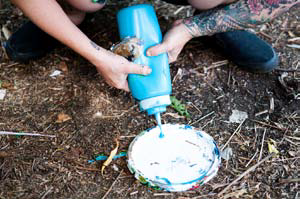
I purchased my paint by the gallon at Nova Color Paints. After it arrives in the mail I mix the main colors I'll need for the mural and put them in 32-ounce wide-mouth condiment squeeze bottles. This helps to reduced wasted paint that can result when more paint is spooned out than is actually used. This can be common particularly when working with a lot of volunteers at once.
Photo by Martin Evans
Buckets with lids
I use the empty gallon paint buckets from Nova Color Paint to hold the water I used to clean my brushes. The lids from these bucks make excellent palettes. They had a nice rim that help contain the paint.
Photo by Robin Corbo Photo by Martin Evans
Scaffolding
I use multiple-tiered scaffolding when I'm working on murals
10-30 ft tall. I rent it from a tool rental company that do not
require that their customers have a contractor's licence.
I prefer to use scaffolding that has wheels and leveling jacks.
If you are in the Portland I highly recommend
http://www.portlandrentall.com/
Step ladders Photos by Robin Corbo
Scaffolding can hold only so many people at once. Having two or three step-ladders on hand
is very useful when you work with 10 or more people at a time.
Chalk snap line and powdered chalk
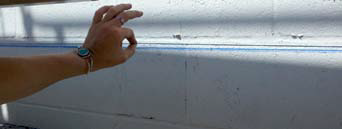
I use a grid pattern to transfer my design onto the surface of the wall. I used a snap line to create the grid. I used red chalk for the center horizontal line and the center vertical line. I used blue chalk for the other lines.
Photo by Robin Corbo
Tape measure
This is very important for accurately measuring out the space between lines when drawing out the grid.
Level
A level is recommended when you are using the snap line to make sure your lines are even with one another. I also use a level to check my scaffolding to see if it is leaning too much one way or another. This can make it shaky and feel unsafe. The level helps me keep it balanced, especially when it is located on uneven ground.
Photo by Robin Corbo
Painter’s tape
This is great for hanging up visual aids that you are painting from without pulling off any paint when it is removed.
Drop cloths
Drop cloths provides easy cleanup for catching all drips and spills that hit the pavement.
Rags
I used cut up old clothes, blankets, and towels for rags. Rags are great for wiping excess water off of brushes and cleaning up drips and spills.
Murphy’s Oil Soap
This is the best soap I’ve used to clean off my paintbrushes. It leaves the bristles soft and helps the brushes last longer.
How do I figure out how much to charge for a mural?
Depending on the specification of the mural project there can be different ways to determine a fair price for both the artist/s and the client. I typically charge my services by the hour. for the amount of time that you predict it will take for you as the lead artist to complete the mural, along with any staff paid staff. I charge $35.00 an hour for my work and $20.00 an hour for assistant muralists. I have found that it is the amount of detail in the mural that dictates how long it takes for me to complete a project as well as the square footage of the surface of the wall. Below is a typical budget I'll use for a mural between 1600 to 2000 square feet:
Expense: Cost:
●Lead Artist Fee (143 hrs) $5,000
●Assistant Artist Fees (330 hrs) $6,600
●Wall prep $500
●Bark Administration Cost $1,000
●Paint $900
●Brushes $100
●Painting Materials $100
●Mural Permit $50
●Documentation and Printing $100
●Scaffolding $650
Total $15,000
Q: I want to paint a mural but I don't have a location for it. What should I do?
Photo by Martin Evans
Photo by Robin Corbo,
A: I have partnered with organizations in the past who knew what neighborhood they wanted their mural to be, but they did not have a building that it could be painted on. Once I knew the general area they wanted their mural to be located I followed these steps:
-
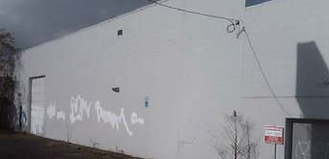
I would bike, drive, or walk around the neighborhood and make a list of walls that would ideal to paint a mural on.
-
I would type of a mural proposal that included a general description of the project and a rough sketch of the design.
-
I would walk into the building and ask to speak to the manager.
-
I would introduce myself as a local muralist and identify any organizations I was working in partnership with to create a mural. I would inform the manager that their location was an excellent location for the project and would be free of charge to the business and the building owner. I would also offer a guarantee that should any graffiti or damage occur to the mural I would be responsible for its restoration. I would then give the manager a printed copy of proposal, complete with my contact information and samples of my past work.
-
It the manager responded positively to my pitch I would ask to be put in touch with the business owner.
-
Once I was able to contact the business owner I would deliver a similar pitch. If the business owner responded positively and was not the owner of the building then I would ask to be put in touch with the building owner.
-
I would then contact the building owner and describe the mural project and how I believed hosting public art would benefit their investment. The benefits I describe to managers, business owners, and building owners are:
●Murals bring a lot of attention to the business who host them. People become more familiar with their location because of the
increased visibility. Murals often provide an unofficial kind of landmark status to their site.
●Walls painted with murals are less likely to accumulate urban blight. Nationwide thousands of dollars and spent on mural
projects and programs by different cities as an anti-graffiti initiative.
●Businesses who host murals are doing a civic service to the surrounding community. This is often appreciated by consumers
and can increase their patronage.
Q: I would like to include children in the mural painting. How can I incorporate kids of different ages and artistic abilities?
Photo by Robin Corbo Photo by Robin Corbo Photo by Kamyar Jahan Photo by Martin Eva
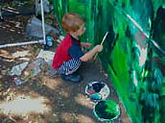
A: A lot of insurance policies do no cover individuals under the age of 16 on scaffolding. Incorporate imagery in your mural design that is close to the ground that kids can reach while standing or sitting on the ground. I recommend designing the bottom portion of your mural with things children could have fun painting that can also work aesthetically when painted loosely. Grass, flowers, leaves, bushes and hand prints are all commonly used for the purpose. Another way to involve kids is get them to paint during the early stages of the mural. This would be when items are outlined and need an under painting filled in before you can add details. This stage can be a lot of fun and very accessible to children and adults who don't have much painting experience.
Photo by Robin Corbo Photo by Kamyar Jahan (Editor's note: This volunteer was an AMAZING painter with tons of experience!)